
Origin
Single-belt traceability
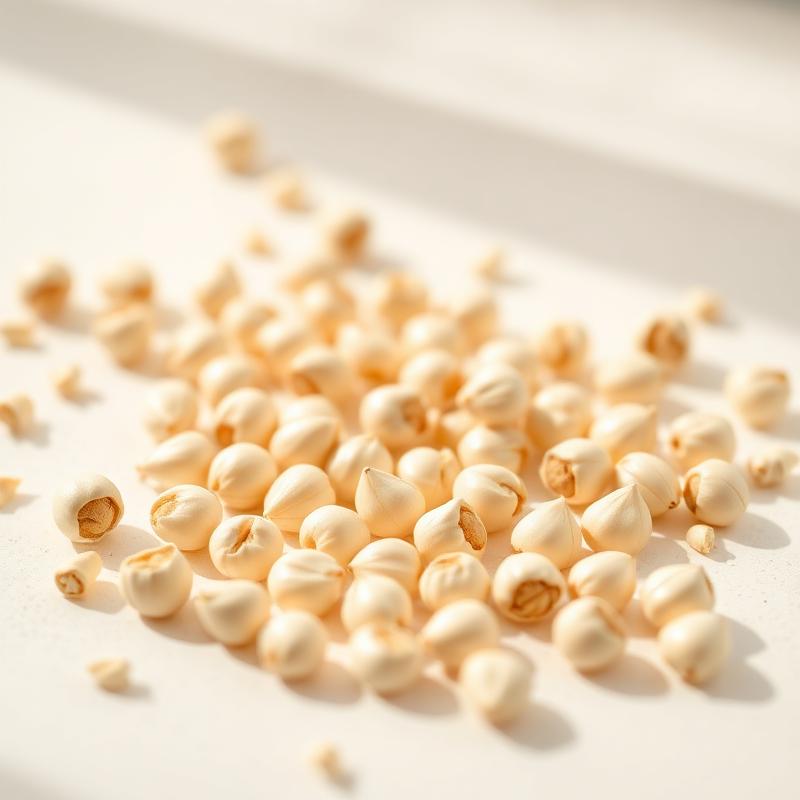
Lots traced to district and pond cluster, supporting GI claims, organic scope and origin storytelling on pack.
Pillar guide · Updated 2026
Everything you need before you place a first order: how suta grading decides your cost, what your market requires on the label, which documents clear customs, and what actually drives landed cost. Written for importers, distributors, supermarket buyers and private label brands.
Makhana has moved from a regional Indian ingredient to a globally traded better-for-you snack base. This guide sets out how the trade works end to end, so you can evaluate suppliers on facts rather than brochures.
Makhana — also traded as fox nuts, gorgon nuts, lotus seeds or by its botanical name Euryale ferox — is the popped kernel of an aquatic plant grown in the still-water ponds of eastern India. The raw seed is harvested from pond beds, sun dried, tempered, roasted in cast iron pans and struck at a precise moment so the starchy kernel bursts out of its hard black shell as a light, white, spherical puff. What arrives in a buyer's warehouse looks like a simple snack; behind it sits a labour-intensive craft supply chain that has almost no mechanised substitute at the popping stage.
For international buyers the commercial appeal is straightforward. Makhana is naturally gluten free, vegan, low in fat, high in plant protein and free from the top allergens that complicate tree nut sourcing. It fries, roasts, coats and seasons well, holds crunch in a laminate pack for nine to twelve months, and sells as a clean-label alternative to popcorn, extruded snacks, chips and rice cakes. Retail buyers in the United States, the United Kingdom, the European Union, the Gulf, Canada, Australia and Southeast Asia have all built listings around it in the last five years, and food manufacturers now use it as a bulking and texturising base in cereal, trail mix and protein snack formats.
India supplies the overwhelming majority of the world's makhana. Within India, the Mithila belt of North Bihar accounts for the large majority of national output and holds the Geographical Indication registration for Mithila Makhana. Every serious export programme therefore begins in the same few districts — Darbhanga, Madhubani, Purnia, Katihar, Saharsa, Supaul, Araria and Kishanganj — and differentiates itself through grading discipline, food safety testing, packaging engineering and documentation rather than through access to the raw material itself.
Domestic Indian trade is tolerant of variation. Lots are frequently mixed across grades, moisture is judged by hand, broken content sits high, and packaging is a simple woven sack. An export lot is a different product built from the same raw material:
It is single-grade and sieve-calibrated so every kernel in the carton falls within a stated diameter band. It is dried to a controlled 5–7% moisture so it survives a monsoon-season container crossing without softening. It is metal detected, colour sorted and hand-picked to remove burnt, yellowed, unpopped and broken pieces. It is lab tested for aflatoxin, pesticide residues, heavy metals and microbiology against the destination's limits. It is packed in food grade liners inside export cartons that survive multi-leg handling. And it arrives with a document set that clears customs without a query.
Each of those steps costs money, and the difference between a cheap quotation and a workable one is almost always one of them being skipped. The sections that follow explain what to specify so the comparison between two quotations is genuinely like-for-like.
85%+
Of world supply from India
5–7%
Target moisture on export lots
9–12
Months shelf life, sealed pack
500 kg
Commercial trial MOQ
“Two quotations for ‘export quality makhana' can differ by 40% and both be honest — one is graded, tested and nitrogen flushed, the other is a mixed lot in a woven sack.”
Origin concentration, an established export framework and a craft workforce make India the only realistic source for consistent commercial volumes.
Fox nut cultivation needs a specific set of conditions that very few geographies offer at scale: shallow perennial ponds and oxbow lakes, warm humid summers, a monsoon that refills water bodies on schedule, and — critically — a workforce that knows how to harvest seed from pond beds and pop it by hand. China cultivates a related species for its own domestic market, and pockets of production exist elsewhere in South and East Asia, but neither generates exportable surplus in the grades that international retail requires. India is where the crop, the craft and the export infrastructure overlap.
Because production is concentrated in a defined belt, buyers can trace lots to district and cluster level rather than to an anonymous aggregation point. That matters for organic certification, for GI claims, and for any brand that wants to tell an origin story on pack with evidence behind it.
India's agri-export framework is well developed. APEDA registers and supports exporters of processed and agricultural food products. DGFT issues the Importer Exporter Code that authorises international trade. FSSAI governs food safety domestically and issues health certificates for export consignments. Plant Quarantine issues phytosanitary certificates. NABL-accredited laboratories issue the residue and contaminant reports that EU and US buyers require. None of this has to be built from scratch for a new buyer relationship.
Makhana is one of the crops named in India's agri-export and food-processing policy push, with a dedicated research and development focus, cluster development in Bihar and targeted support for processing and cold-chain infrastructure. Practically, that means better popping units, more mechanised grading lines and rising availability of certified organic acreage in the same belt.
Consignments move by sea from Nhava Sheva (JNPT) and Mundra for westbound routes and from Kolkata / Haldia for East and Southeast Asia, and by air from Delhi, Mumbai and Kolkata. Because makhana is light and voluminous, air freight for samples and small top-up orders is unusually practical compared with denser agricultural commodities.
The combination of local raw material, local processing and local printed packaging means a brand owner can land a fully finished, retail-ready private label SKU at a landed cost that no re-packing operation in a destination market can match. That is why most makhana brands in the US, UK and Gulf are manufactured in India rather than imported in bulk and packed locally.
Origin
Lots traced to district and pond cluster, supporting GI claims, organic scope and origin storytelling on pack.
Compliance
APEDA, DGFT IEC, FSSAI, Plant Quarantine and NABL labs already exist around the commodity.
Craft
Hand popping remains the only method that produces high-suta, unbroken, uniformly white kernels at volume.
Logistics
JNPT and Mundra westbound, Kolkata and Haldia eastbound, with air options from three gateways.
Cost
Raw material, processing, printed film and filling in one country keeps retail-ready landed cost competitive.
Scale
Post-harvest stocking and contracted call-offs allow year-round supply against a fixed annual price.
The Mithila belt of North Bihar produces the whitest, roundest and most uniform kernels — the specification international retail buyers actually ask for.
Mithila is the cultural and agricultural region spanning Darbhanga, Madhubani, Samastipur, Saharsa, Supaul, Madhepura and neighbouring districts of North Bihar, extending into the Terai. Its landscape is defined by thousands of perennial ponds and oxbow lakes formed by the shifting channels of the Kosi, Kamla, Bagmati and Gandak rivers. Those water bodies — shallow, nutrient-rich, slow moving and warm — are close to a perfect habitat for Euryale ferox.
Seed grown in these conditions is larger and denser than seed from marginal water bodies, and dense seed pops into a bigger, rounder, whiter kernel with a thinner residual skin. Buyers see this as three measurable outcomes: a higher proportion of the lot passing into the premium suta grades, a lower broken percentage after transit, and a cleaner white colour without the greyish or yellow cast that comes from over-roasting weaker seed.
Popping is where most of the value is created or destroyed, and it is still done by hand by families who have done it for generations. Dried seed is graded by size, tempered, roasted in a hot pan, rested, then roasted again and struck with a wooden mallet within a window of a few seconds. Strike early and the kernel does not fully expand; strike late and it scorches. A skilled worker reads that window by sound and colour. This is why fully mechanised makhana at premium grades does not yet exist at commercial scale, and why sourcing from a belt with deep generational skill produces a visibly better product.
Because so many producing households sit inside a small geography, an exporter working in Mithila can build a single large lot from clusters using the same seed stock, the same harvest window and comparable popping practice. Consistency across a container — the thing that actually breaks retail programmes — comes from that density. A lot assembled from scattered origins looks fine in a sample bag and fails on the shelf.
There are two ways to buy raw popped makhana in India. The first is to buy assembled lots at a wholesale mandi, which is fast, cheap and completely opaque on origin, moisture history and handling. The second is to contract directly with farmer clusters and popping units, take delivery at a controlled facility and run your own grading, drying and testing. Only the second supports organic certification, GI substantiation, aflatoxin control and repeatable grade yields. It is the model we operate.
A Geographical Indication is a legally protected origin mark. Used correctly it is a defensible marketing claim; used loosely it is a compliance risk.
A Geographical Indication (GI) is an intellectual property right that identifies a product as originating from a defined place, where a given quality, reputation or characteristic is essentially attributable to that origin. Champagne, Darjeeling tea and Parma ham work the same way. Mithila Makhana was granted GI registration in India in 2022, with the registration held for the benefit of producers in the notified districts of the Mithila region.
The GI covers origin and the traditional method associated with it: makhana cultivated and processed within the notified area, using the established harvesting, drying, roasting and popping practice of the region. It is a statement about provenance and process. It is not a food safety certificate, not a grade standard, and not a substitute for a certificate of analysis. A GI lot still has to be graded, tested and documented like any other.
Three reasons. First, differentiation: “GI tagged Mithila Makhana” is a protected, verifiable origin claim in a category where most competitors say nothing more specific than “Product of India”. Second, defensibility: because it is a registered right, the claim survives retailer and regulator scrutiny in markets that police origin claims tightly. Third, consistency: the notified area is precisely the belt that produces the premium-grade kernel, so the origin claim and the quality claim point in the same direction.
Only product genuinely sourced from the notified region may be described as Mithila Makhana, and the claim should be supported by documented traceability from pond cluster to packed lot. We supply origin declarations naming the sourcing districts, batch-level traceability records, and a certificate of origin consistent with the claim. If a lot is blended with material from outside the notified area — occasionally necessary in a short season — we say so and the GI wording comes off the pack. Buyers should treat any supplier who is casual about that distinction as a risk to their own label compliance.
| Claim on pack | What must be true | Evidence we provide |
|---|---|---|
| GI Tagged Mithila Makhana | 100% of the lot sourced within the notified Mithila districts | Origin declaration, cluster-level traceability sheet, certificate of origin |
| Product of India | Grown and processed in India, origin belt unrestricted | Certificate of origin, exporter declaration |
| Organic Makhana | Certified organic pond clusters, segregated processing run | NPOP / NOP-EU scope certificate plus transaction certificate per lot |
| Handpicked Premium | 22 mm+ kernels, manually sorted, broken under 2% | Grade specification sheet and pre-shipment inspection report |
Suta grading measures popped kernel diameter. Getting the grade right for your channel is the single biggest lever on both cost and shelf performance.
The Indian trade grades makhana in suta, a traditional unit that maps to the diameter of the popped kernel measured on a calibrated sieve. Higher suta means a larger, rounder, whiter kernel — and a lower yield per kilo of raw seed, which is why price rises steeply with grade. Below the sieve, three further attributes determine whether a lot is export quality: whiteness (a clean white without grey or yellow cast), wholeness (percentage of unbroken kernels) and foreign matter (unpopped seed, shell fragments, dust).
A common and expensive mistake is over-specifying. A jumbo grade in a bulk food manufacturing application, where the kernel is going to be milled, coated or crushed anyway, wastes margin. Equally, under-specifying a premium retail pack destroys the visual impression the pack depends on. Match the grade to the channel.
| Grade | Diameter | Colour & wholeness | Best suited to |
|---|---|---|---|
| 4 Suta | 14–16 mm | Off-white, up to 8% broken | Food manufacturing, milling, coated snacks, bulk catering |
| 5 Suta | 16–18 mm | White, up to 5% broken | Value retail packs, trail mixes, roasted snack lines |
| 6 Suta | 18–20 mm | Bright white, under 4% broken | Mainstream retail, supermarket private label, HORECA |
| 6+ Suta / Jumbo | 20–22 mm | Bright white, under 3% broken | Premium retail, flavoured snack brands, e-commerce |
| Handpicked Premium | 22 mm and above | Uniform white, under 2% broken | Gifting, luxury retail, duty free, airline and hospitality |
| Parameter | Export specification | Test method / reference |
|---|---|---|
| Moisture | 5–7% maximum | Oven drying, AOAC |
| Aflatoxin B1 / total | < 2 ppb / < 4 ppb (EU reference) | HPLC, NABL lab |
| Pesticide residues | Within EU MRL panel | GC-MS / LC-MS-MS multi-residue |
| Foreign matter | Nil visible | Manual + optical sorting |
| Unpopped seed | < 0.5% | Sieve and visual inspection |
| Metal contamination | Nil | In-line metal detection, Fe/Non-Fe/SS |
| Total plate count | < 10,000 cfu/g | Microbiological panel |
| Yeast & mould | < 100 cfu/g | Microbiological panel |
| Salmonella / E. coli | Absent in 25 g | Microbiological panel |
The same graded kernel feeds four commercial formats. Plain makhana is the raw popped kernel, unseasoned, and is the base for manufacturers and repackers. Roasted makhana is oil or air roasted for crunch and shelf stability with light or no seasoning. Flavoured makhana carries seasoning systems built for the destination palate — peri peri, cheese, sour cream, himalayan salt, caramel, pudina. And organic makhana runs the certified supply chain end to end for buyers whose retail listing requires it.
Makhana is hygroscopic and fragile. Packaging is not cosmetic on this product — it is the primary quality control after grading.
Two forces degrade makhana in transit. The first is moisture pickup: the kernel is porous and will absorb humidity from the air inside a container, losing crispness long before any microbiological issue appears. The second is mechanical breakage: a light, hollow sphere crushes under compression, so stack height, carton strength and void fill decide how much of your lot arrives whole. A shipment that leaves India at 6% moisture and under 2% broken can land at 9% and 12% broken purely because of packing decisions.
Our default bulk structure is a food grade LDPE inner liner inside a multilayer laminated bag, inside a five-ply export carton. For humid destinations and long sea legs we recommend nitrogen flushing or vacuum packing, which displaces oxygen and moisture and materially extends the crisp shelf life. For retail formats we use metallised PET / PE laminates or paper-look barrier structures where a recyclable or premium natural aesthetic matters.
| Format | Fill weight | Structure | Typical use |
|---|---|---|---|
| Bulk export carton | 5 / 10 / 20 kg | LDPE liner + laminated bag + 5-ply carton | Manufacturers, repackers, distributors |
| Vacuum / nitrogen bulk | 5 / 10 kg | Barrier laminate, N₂ flushed | Humid climates, long sea transit, premium grades |
| Retail pouch | 20 g – 250 g | Metallised PET/PE, zip option | Supermarket, e-commerce, private label |
| Stand-up gusset pouch | 100 g – 500 g | Matte laminate with window option | Premium retail, gifting, specialty stores |
| Institutional pack | 1 / 2 / 5 kg | Laminated bag in carton | HORECA, cloud kitchens, catering |
| Sample kit | 50 g × grade set | Sealed pouches, labelled by grade | Buyer evaluation before contract |
Makhana cubes out long before it weighs out. A 20 ft container typically carries 6–8 MT and a 40 ft high cube 14–16 MT, depending on grade and carton size. Cartons are palletised and stretch wrapped where the destination requires ISPM-15 treated wood or plastic pallets, or floor loaded with dunnage where hand unloading is preferred. Desiccant bags and container liners are used on monsoon and tropical routes to control condensation. Loading photographs and container seal numbers are shared for every shipment.
Labelling is a compliance surface, not a design surface. The EU requires ingredient listing, allergen emphasis, nutrition declaration per 100 g, net quantity, lot code, date marking and an EU-based food business operator address. The US requires the FDA Nutrition Facts panel format, ingredient statement, allergen statement and a US distributor address. GCC markets require bilingual Arabic and English labelling with production and expiry dates and, where applicable, halal marking. We generate compliant artwork for the destination as part of every private label programme.
From first enquiry to delivered container, most buyers complete the cycle in three to five weeks. Here is exactly what happens at each stage and what we need from you.
You share grade, monthly volume, packaging format, destination port and Incoterm. Our export desk acknowledges the same working day and flags any destination-specific compliance issues up front.
Reference samples of the exact grade are couriered with lot photographs and a specification sheet. Air courier takes 3–7 days. Sample cost is credited against the first commercial order.
A priced offer on EXW, FOB, CFR or CIF terms is issued within 24–48 business hours, with validity, payment terms, packing specification and delivery window stated in writing.
Proforma invoice against advance TT, irrevocable LC at sight, or agreed credit terms for repeat buyers. Production is scheduled on receipt of confirmation.
Raw lots are called from contracted clusters, popped, dried to target moisture, graded, sorted and — for value-added lines — roasted, seasoned or filled to your private label specification.
Moisture, size distribution, broken percentage, colour and metal detection are verified in-house; aflatoxin, pesticide residue, heavy metal and microbiological testing is done at an NABL-accredited lab. Third-party inspection on request.
Commercial invoice, packing list, certificate of origin, phytosanitary certificate, FSSAI health certificate, certificate of analysis and any fumigation, halal or organic transaction certificates are prepared in-house.
Container stuffed, sealed and photographed; BL or AWB released; tracking and ETA shared with your clearing agent. Documents are couriered ahead of arrival and a post-delivery quality review closes the cycle.
| Destination region | Sea freight | Air freight | Typical load port |
|---|---|---|---|
| Gulf / GCC | 8–14 days | 3–4 days | Nhava Sheva, Mundra |
| Southeast Asia | 14–20 days | 3–5 days | Kolkata, Nhava Sheva |
| UK & Northern Europe | 20–28 days | 4–6 days | Nhava Sheva, Mundra |
| US East Coast | 26–34 days | 5–7 days | Nhava Sheva |
| US West Coast | 30–38 days | 5–7 days | Nhava Sheva |
| Australia & New Zealand | 18–26 days | 5–7 days | Nhava Sheva, Kolkata |
| Canada | 28–36 days | 5–7 days | Nhava Sheva |
| Japan & Korea | 18–24 days | 4–6 days | Kolkata, Nhava Sheva |
Each market has its own labelling law, port practice and pack-size expectation. We maintain a dedicated brief for every market we ship to.
Demand patterns differ sharply by market and they should shape your first order rather than being discovered after it. North America buys heavily into flavoured and roasted formats in 28–85 g single-serve packs, with FDA Nutrition Facts labelling and a US distributor address on pack. The United Kingdom and the European Union skew towards clean-label and organic positioning, apply the strictest aflatoxin and pesticide limits, and require full EU labelling with an EU-based food business operator. The GCC takes both bulk and retail, requires bilingual Arabic labelling and often halal documentation, and rewards fast replenishment because of short sea legs. Southeast Asia and East Asia lean towards plain and lightly seasoned grades for further processing. Australia, New Zealand and Canada behave like premium retail markets with rigorous import documentation.
Americas
FDA labelling, flavoured single-serve, East and West Coast ports.
Americas
Bilingual labelling, premium retail and health food channels.
Europe
Organic and clean label focus, Felixstowe and Southampton.
Europe
Strict residue limits, organic retail, Hamburg entry.
Europe
Rotterdam as EU distribution hub for onward markets.
Middle East
Jebel Ali, bilingual packs, fast replenishment cycles.
Middle East
SFDA compliance, halal documentation, Dammam and Jeddah.
Middle East
Premium retail and hospitality demand, Hamad Port.
Asia Pacific
Re-export hub, plain and lightly roasted grades.
Asia Pacific
Exacting spec on colour and breakage, small precise lots.
Asia Pacific
Strict biosecurity, premium retail pack formats.
Asia Pacific
MPI documentation, health food and specialty retail.
A practical checklist drawn from the questions serious importers ask — and the ones that separate a reliable supplier from a trading intermediary.
A large share of makhana “exporters” are trading intermediaries who buy assembled lots at a mandi and re-invoice them. That is not inherently disqualifying, but it changes what they can promise. Ask directly: do you contract with farmer clusters, do you own or control the processing and packing facility, and can you show me traceability from pond to lot? An intermediary cannot guarantee grade yields, cannot support organic certification and cannot fix a quality problem at source.
Price is meaningless without grade, moisture, broken percentage, colour standard, packaging structure and test limits attached to it. Insist that the proforma invoice carries the full specification. If the supplier resists, the quotation is not for the product you think it is.
Ask for samples of the actual grade you intend to buy, ideally from a recent production lot, with the lot number, packing date and a copy of the certificate of analysis. Retain half of every sample. A retained sample is your only objective reference if a shipment is disputed later.
Check that the lab is NABL accredited, that the report date is recent and matches the lot, and that the tested parameters match your destination's limits rather than a generic panel. For EU imports, aflatoxin and pesticide MRLs are the two lines that most often cause a border rejection.
FOB gives you control and usually the best freight rate if you have carrier contracts. CIF is simpler for a first import and gives you a single landed number to work with. EXW only makes sense if you have a competent Indian freight forwarder. DDP shifts everything to the supplier and prices accordingly. Whichever you choose, confirm who is responsible for destination charges, demurrage and customs duty in writing.
Standard practice on a first order is 30% advance with the balance against a scanned bill of lading, or an irrevocable letter of credit at sight. Neither party should be fully exposed. Be cautious of any supplier demanding 100% advance on a first transaction, and equally of one offering open credit without a trading history.
A 500 kg to 1 MT trial that moves by air or LCL teaches you more than any amount of correspondence: you see the real grade, the real moisture on arrival, the real breakage after handling and the real quality of the document set. Scale to full containers after that.
Raw seed is harvested July to September. Prices are typically softest from September to December and tighten toward the end of the cycle. If you need year-round supply at a stable cost, negotiate an annual contract with scheduled call-offs instead of repeated spot purchases.
Bulk moves quickly and gives you packing flexibility at destination. Private label lands retail-ready at a lower total cost but adds 5–7 weeks for artwork, film and tooling on the first run. Mixing both — bulk for food service, private label for retail — is common and efficient once volumes justify it.
Ask for the IEC, APEDA registration, FSSAI licence, the processing unit's ISO 22000 or HACCP certificate, the organic scope certificate if relevant, and references from buyers in your region. Request a facility visit or a video walkthrough. Any supplier who is going to sit behind your brand on a supermarket shelf should welcome that scrutiny.
| Item | Standard terms |
|---|---|
| Trial MOQ | 500 kg per grade, bulk cartons |
| Container economics | 20 ft ≈ 6–8 MT · 40 ft HC ≈ 14–16 MT |
| Private label MOQ | 1,000–5,000 units per SKU by pack format |
| Incoterms quoted | EXW, FOB, CFR, CIF, DDP (selected markets) |
| Payment | 30% advance + balance against BL, or irrevocable LC at sight |
| Quotation turnaround | 24–48 business hours |
| Sample dispatch | 3–7 days by air courier |
| Production lead time | 10–15 days for bulk, 5–7 weeks first private label run |
The same graded kernel serves eight distinct buyer segments, each with a different grade, pack format and price expectation.
01
6 Suta and above in 20–100 g printed pouches, own-label or brand, with destination-compliant nutrition panels and barcodes.
02
Bulk cartons in 5–20 kg for onward repacking or distribution, quoted FOB or CIF with full container economics.
03
Plain 4–5 Suta as a base for coating, seasoning, extrusion blends and multi-texture snack formats.
04
Low-fat, gluten-free, plant-protein base for protein puffs, keto snacks and diabetic-friendly ranges.
05
1–5 kg institutional packs for hotels, restaurants, cloud kitchens and banqueting garnish and snack service.
06
Handpicked premium in sealed single-serve portions for inflight service and duty-free gifting assortments.
07
Retail-ready private label with e-commerce durable outer packaging and fast SKU iteration for online catalogues.
08
Uniform sized kernels that hold structure in granola, muesli, trail mix and breakfast cereal applications.
Nutritionally, makhana supports most of these positions without reformulation: roughly 9–10 g protein and 76–80 g carbohydrate per 100 g with under 1 g fat, no gluten, no cholesterol and a useful magnesium, potassium, phosphorus and calcium contribution. It is naturally free of the major allergens, which simplifies both factory allergen control and on-pack declarations compared with tree nut based snacks.
See the industries we serve for segment-specific specifications, or the wholesale supply programme for distributor pricing structures.
Every certification below is either held by us or issued per consignment. Ask for current copies with your quotation — a serious supplier will send them without hesitation.
| Certification | Issued by | What it covers |
|---|---|---|
| APEDA Registration | Agricultural & Processed Food Products Export Development Authority | Authorises and supports export of processed agricultural products from India |
| IEC (Importer Exporter Code) | DGFT, Government of India | Mandatory statutory authorisation to conduct international trade |
| FSSAI Licence | Food Safety and Standards Authority of India | Domestic food safety compliance and issuance of export health certificates |
| ISO 22000 / HACCP | Accredited certification body | Food safety systems at our Darbhanga plant and contracted processing units |
| Organic — NPOP / NOP / EU | Accredited organic certification body | Certified organic scope plus per-lot transaction certificate |
| Phytosanitary Certificate | Plant Quarantine, Government of India | Consignment-level plant health clearance for import at destination |
| Certificate of Origin | Chamber of Commerce / competent authority | Declares Indian origin; preferential form where an FTA applies |
| Certificate of Analysis | NABL-accredited laboratory | Moisture, aflatoxin, pesticide residues, heavy metals, microbiology per lot |
| Halal Certification | Recognised halal certification body | Required for several GCC and Southeast Asian retail listings |
| MSME / Startup India | Government of India | Registered Indian manufacturing entity credentials |
Compliance failures at the border are almost always documentation failures rather than product failures. The recurring causes are a certificate of analysis that does not test the parameter the destination cares about, a label missing a mandatory element such as an EU food business operator address or an FDA-format nutrition panel, a certificate of origin inconsistent with the invoice, or a phytosanitary certificate issued against the wrong description. We pre-check the document set against destination requirements before the container is stuffed, and send scanned copies for your broker to review while the vessel is still at sea.
Full certificate copies are available on the quality and certifications page.
Short, direct answers to the questions we get most often from importers, distributors and brand owners.
It is eight stages — inquiry, sampling, quotation, production, inspection, documentation, shipping, delivery — and takes four to six weeks from first email to vessel departure. You send us your requirement and we reply within 24-48 hours with a quotation and specification sheet. Reference samples reach you in 3–5 working days by courier. You confirm with a purchase order and advance or letter of credit, and the lot is processed, graded and packed at the contracted unit. Moisture, size and broken percentage are verified before stuffing, with third-party inspection on request. We then prepare the full document set in-house, book the container, complete customs, and share tracking with your clearing agent, couriering documents ahead of arrival.
For loose bulk makhana the practical minimum is 500 kg for air freight and one container load for sea freight — around 6–8 MT in a 20ft container and 14–16 MT in a 40ft high cube, since makhana is very light and cubes out before it weighs out. For private label retail packs the MOQ is 1,000–5,000 units per SKU depending on pack format, driven by the printed-film minimum rather than by us. First-time buyers can start with a smaller trial shipment while a relationship is being established.
Most orders move by sea in FCL containers from Nhava Sheva, Mundra or Kolkata; urgent or sample volumes go by air from Delhi or Mumbai. We work on FOB, CFR, CIF and DDP terms, whichever suits your freight arrangement. Because makhana is low density, we plan the load by volume so you are not paying for half-empty containers, and we can consolidate multiple grades or SKUs into a single container.
Samples reach you in 3–5 working days by courier. A confirmed bulk order is ready to ship in 10–15 days; repeat private label orders take 20–30 days, and a first private label run ships 5–7 weeks from artwork sign-off because pouch printing and tooling are added. Sea transit then depends on the lane — roughly 6–14 days to the Gulf, 19–26 days to Europe, 20–26 days to the UK, 26–34 days to the US east coast, and 8–12 days to Southeast Asia. Air freight lands anywhere in three to seven days.
Plain and roasted makhana (fox nuts, Euryale ferox) is exported under HS code 08029900, the residual line for other shelled edible nuts. Flavoured, seasoned or retail-packed snack preparations are usually classified under 20081910. Private label retail packs occasionally move under 21069099 depending on the recipe. We state the code on the proforma invoice and your customs broker confirms the classification accepted at the destination port before the container is booked.
Our commercial MOQ is 500 kg for a single grade in bulk cartons, which suits first trial orders and air freight. Sea freight becomes economical from roughly 3,000 kg. A 20 ft container holds about 6–8 MT of makhana depending on packing density, and a 40 ft HC holds 14–16 MT. Private label retail packs carry a separate MOQ of 1,000–5,000 units per SKU depending on pack format, because of printed film and carton tooling.
Grading is done by popped diameter measured on a calibrated sieve, then sorted for colour, wholeness and broken percentage. Common export grades are 4 Suta (14–16 mm), 5 Suta (16–18 mm), 6 Suta (18–20 mm), 6+ Suta / Jumbo (20–22 mm) and Handpicked Premium (22 mm and above). Higher suta grades are whiter, rounder, more uniform and command a premium in retail and gifting channels.
Yes. We supply NPOP and NOP/EU equivalent organic makhana against a valid transaction certificate issued by an accredited certification body, with traceability from the certified pond cluster to the packed lot. Organic lots are processed in segregated runs, and the organic scope certificate plus the TC travel with the shipping documents.
Makhana dried to 5–7% moisture and sealed in a multilayer laminate or nitrogen-flushed pack holds 9–12 months. Store between 15–25°C at under 60% relative humidity, away from direct sunlight and strong odours. In humid destination climates, vacuum or nitrogen flushing is strongly recommended to protect crispness through the retail cycle.
We quote EXW, FOB (Nhava Sheva, Kolkata, Mundra), CFR and CIF as standard, and DDP for selected markets through nominated partners. FOB is the most common structure for buyers with their own freight contracts; CIF suits first-time importers who want a landed cost at the destination port.
Yes. Private label covers recipe development, pack format selection, artwork adaptation to destination labelling law, nutrition panel generation, barcode allocation and printed film production. Typical timelines are 2–3 weeks for artwork and approvals, 2 weeks for film and carton production and 1–2 weeks for filling, so first production usually ships 5–7 weeks from artwork sign-off.
Commercial invoice, packing list, bill of lading or airway bill, certificate of origin (preferential where an FTA applies), phytosanitary certificate, FSSAI health certificate, lab analysis report covering moisture, aflatoxin, pesticide residues and microbiology, plus fumigation and non-GMO or organic transaction certificates where required. Copies are couriered and emailed ahead of vessel arrival.
Every lot is tested at an NABL-accredited laboratory before dispatch. We work to EU limits as the default reference — aflatoxin B1 under 2 ppb and total aflatoxin under 4 ppb — which are stricter than most other destinations. Pesticide residue screening follows the EU MRL panel, and heavy metals and microbiology are covered in the same certificate of analysis.
Air freight lands in 3–7 days and is used for samples and urgent top-ups. Sea freight runs roughly 6–14 days to the Gulf, 19–26 days to Northern Europe, 20–26 days to the UK, 26–34 days to the US East Coast and 8–12 days to Southeast Asia, excluding customs clearance at destination.
Raw gorgon nut is harvested between July and September, with popping and grading running through the following months. Prices are typically softest in the post-harvest window from September to December and firm up towards the end of the cycle. Annual contracts with scheduled call-offs let buyers lock a price across the year rather than buying spot.
Yes to both. Buyers are welcome at the processing and packing unit, and we routinely accommodate SGS, Bureau Veritas, Intertek or buyer-nominated inspectors for pre-shipment inspection and container loading supervision. Loading photographs and seal numbers are shared for every container as standard.
Share your grade, monthly volume, packaging format and destination port. Our export desk acknowledges the same working day and returns a priced EXW, FOB, CFR or CIF offer within 24–48 business hours, with samples dispatched in parallel.
Distributor pricing structures, container economics and repeat supply contracts.
Bulk carton formats, MOQs and container loading for high-volume buyers.
OEM manufacturing, artwork, destination labelling and first-run timelines.
NPOP and NOP/EU certified supply with per-lot transaction certificates.
Handpicked jumbo grades for gifting, duty free and luxury retail.
The full eight-stage cycle from enquiry to delivered container.
Market-by-market ports, transit times, labelling rules and pack formats.
APEDA, IEC, FSSAI, ISO 22000, HACCP and organic documentation.
Eight buyer segments with segment-specific grade and pack guidance.